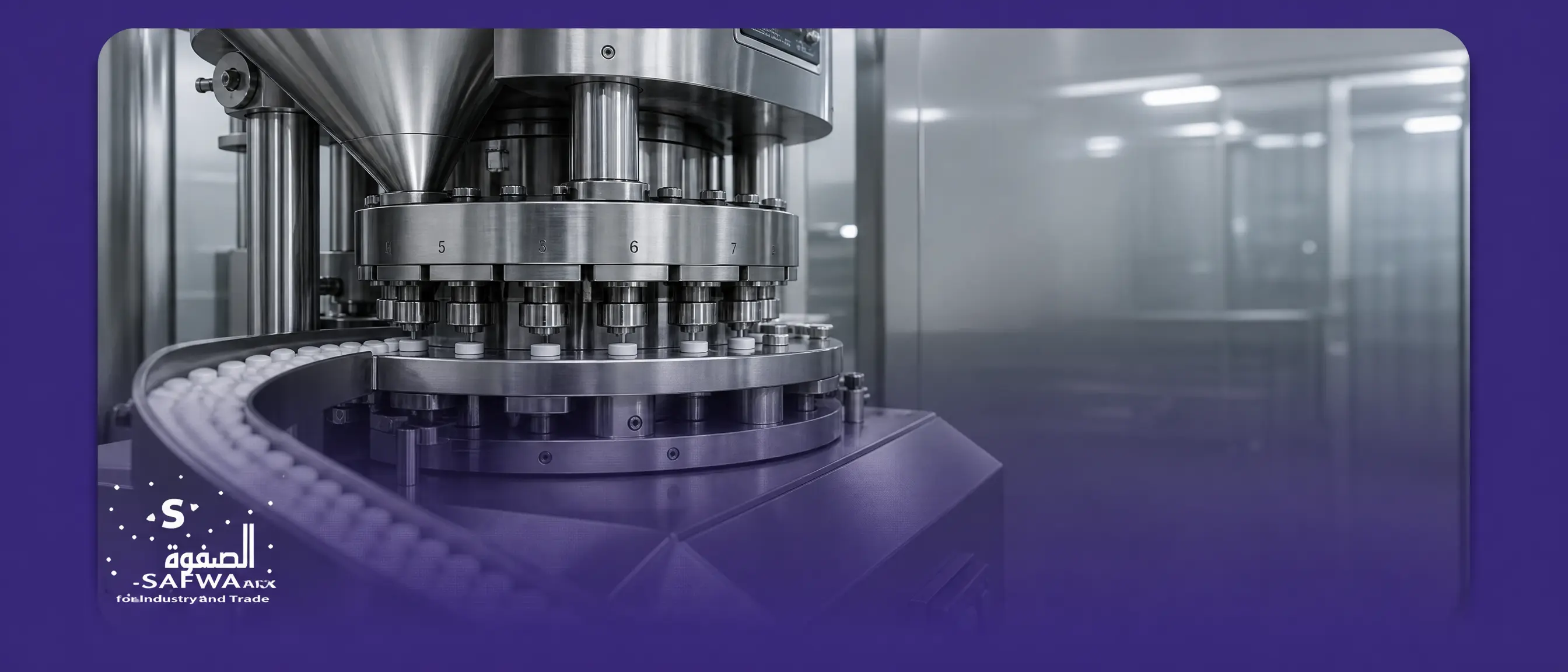
If you are planning to establish a production line for pharmaceuticals or dietary supplements, choosing a tablet press machine for sale is not based on price alone. It is also related to dosage accuracy, tablet-weight consistency, ease of cleaning, and the machine’s ability to operate continuously within an organized production environment. You therefore need a supplier that understands the pharmaceutical industry and can help you choose the right solution—not simply offer a machine with general specifications.
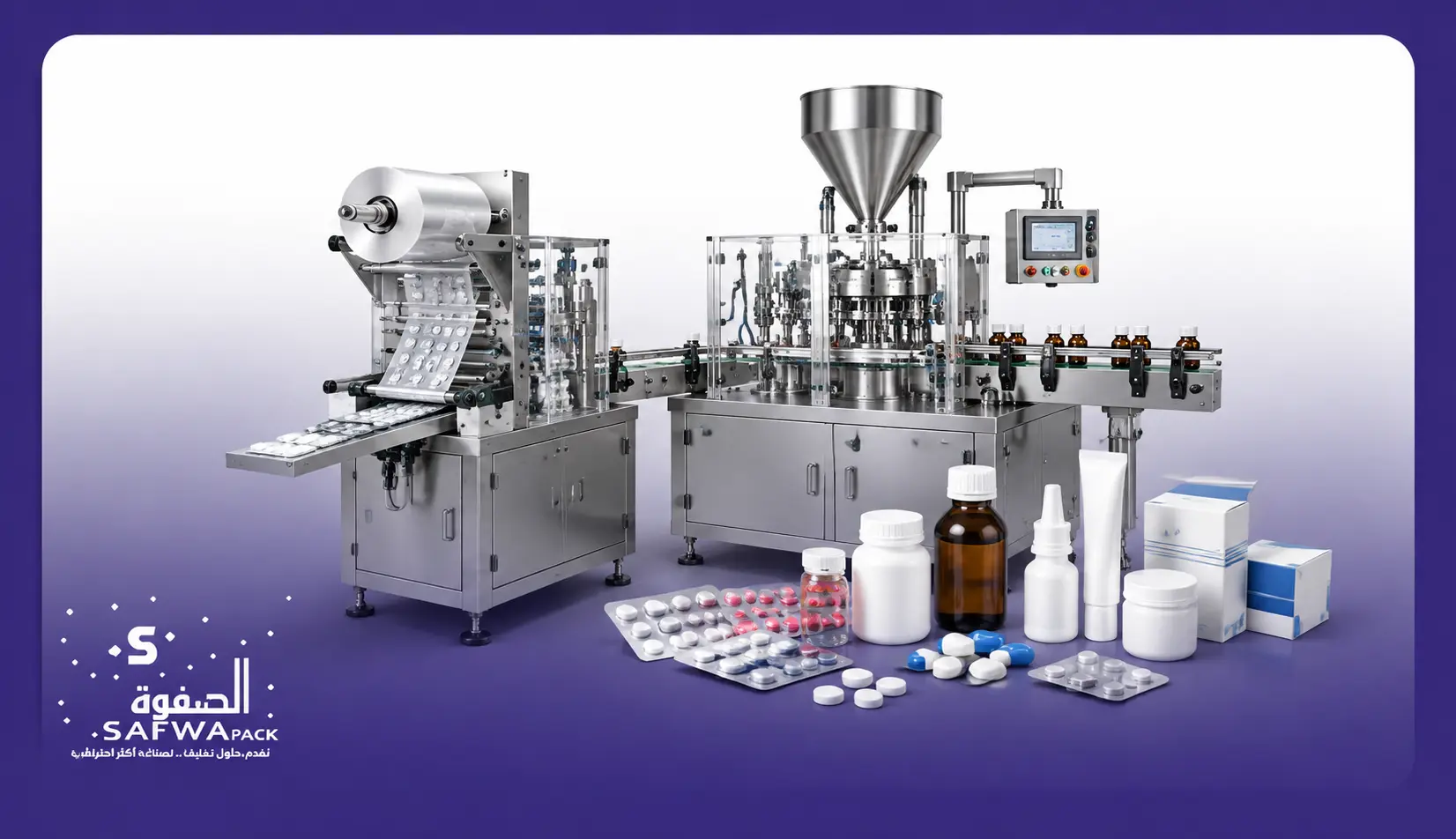
El Safwa provides integrated industrial machinery solutions, with experience in designing and manufacturing filling and packaging equipment, customized solutions for different sectors, technical support, and after-sales services. Its product range also includes pharmaceutical equipment, blister machines, and packaging machines that complement tablet production lines.
What Is a Pharmaceutical Tablet Press?
A tablet press is an industrial machine that compresses prepared powder inside a defined die to turn it into tablets with consistent shape, weight, and thickness. This technology is used in the production of pharmaceutical tablets, vitamins, dietary supplements, and certain permitted food or chemical products.
Tablet presses vary in the number of compression stations, production speed, pressure range, automation level, tooling type, and control method. Therefore, there is no single ideal machine for every factory. The right choice begins by defining the target product, production volume, and quality requirements.
Why Is Demand Growing for Tablet Press Machines for Sale?
Demand for tablet press machines is increasing as new and existing factories seek to raise production capacity, improve tablet consistency, and reduce waste. Using a suitable machine helps achieve better repetition in weight and shape and gives the operating team greater control over pressure and speed according to the formulation.
A tablet press is also a central part of an integrated production line. It can be connected to powder preparation, blending, feeding, inspection, filling, and packaging stages. For this reason, the machine should be evaluated as part of a complete production system, not only as a standalone device.
Types of Tablet Press Machines You Should Know
1. Single-Punch Tablet Press
A single-punch tablet press is suitable for initial trials, research and development centers, and limited-volume projects. It usually operates with one compression station and gives the operator flexibility to test formulations and dies before moving to larger production.
However, it is not the best option when continuous high production speed is the priority.
2. Rotary Tablet Press
A rotary tablet press includes multiple compression stations moving on a rotating turret, allowing the production of a large number of tablets in a short period. Small, medium, and high-speed models are available, and they may support the production of single-layer or multi-layer tablets depending on their design and configuration.
3. Semi-Automatic Tablet Press
A semi-automatic tablet press provides a balance between ease of operation, cost, and production capacity. It is suitable for factories that are growing gradually or require medium production volumes while retaining manual control over certain operating stages.
4. Automatic Tablet Press
An automatic tablet press is used in production lines that require continuous operation, accurate monitoring, and reduced operator involvement. Automation is most beneficial when the factory can provide prepared raw materials, trained operators, and a maintenance, cleaning, and quality-verification program.
Key Specifications When Choosing a Tablet Press Machine
Before purchasing a tablet press machine, request clear written specifications from the supplier. Do not rely on phrases such as “high speed” or “best price” without actual figures and details.
| Specification | Why It Matters |
|---|---|
| Production capacity | Determines the expected number of tablets produced per hour under actual operating conditions. |
| Maximum pressure | Affects the machine’s ability to handle different formulations and achieve the required tablet hardness. |
| Number of compression stations | Related to productivity and the number of dies used during the production cycle. |
| Tablet diameter and thickness | Determines the products and tooling that can be manufactured on the machine. |
| Control accuracy | Helps control weight, pressure, and speed while reducing product variation. |
| Manufacturing materials | Stainless steel and easy-to-clean surfaces are important in pharmaceutical environments. |
| Ease of disassembly and cleaning | Reduces downtime and helps prevent residue transfer between products. |
| Safety system | Protects the operator and machine from incorrect operation or overload. |
| Spare parts and support | Helps ensure continuous operation and fast fault resolution after purchase. |
Before making a decision, ask suppliers to provide technical details such as the number of punches, maximum pressure, production capacity, dimensions, and machine weight.
How Do You Choose a Machine Based on Project Size?
If the project is in the research-and-development stage or requires samples and trials, a single-punch or semi-automatic press may be more suitable than investing in a high-cost line. If the factory targets continuous commercial production, a rotary press with a suitable number of stations and speed will usually be required.
Do not rely only on the maximum advertised capacity. Ask about actual capacity when operating your real product, as well as powder type, moisture level, tablet size, cleaning time, and tooling-change intervals. These details can significantly change cost and return calculations.
When searching for a tablet press machine from a local company or a supplier operating in the Egyptian market, compare spare-parts delivery time, training availability, after-sales service, and access to technicians who can visit your facility.
Is a Tablet Press Used Only for Pharmaceutical Products?
A tablet press is not limited to pharmaceutical tablets. Depending on machine design, tooling, and permitted materials, it can be used to produce dietary supplements, vitamin tablets, herbal tablets, confectionery tablets, or chemical products.
However, one machine should not automatically be considered suitable for all applications. Every product requires testing of material compatibility, tooling, feeding system, and compression settings.
For pharmaceutical products, design, operation, and quality-verification decisions must be part of the factory’s quality system and applicable regulations. The supplier can provide technical data, operating tests, training, and configuration recommendations, while product and process approval remains the responsibility of the manufacturer and relevant authorities.
What Is the Relationship Between a Tablet Press and Blister Packaging?
After tablet production, products usually need appropriate packaging and protection. Blister packaging machines can perform forming, filling, vacuuming, and sealing operations.
Therefore, when requesting a tablet press machine, discuss the next production stage with the supplier as well. Will tablets be packed in blisters? Do you need counting and bottle filling? Are there special requirements for traceability, printing, or carton packaging?
Answering these questions helps build a compatible line instead of purchasing separate equipment that may be difficult to integrate later.
Questions to Ask the Supplier Before Purchase
When contacting a manufacturing or supply company, request a technical quotation that includes the machine model, actual production capacity, tablet-diameter range, maximum pressure, electrical requirements, dimensions, weight, and the materials used in product-contact parts.
Also ask about available tooling, product-changeover capability, warranty period, spare-parts availability, and maintenance program.
It is also important to request a test video or trial using your material when possible, and to confirm whether the price includes shipping, installation, and training. Industrial suppliers may offer additional services such as factory acceptance testing, documentation, commissioning, and operator training. Therefore, clearly define what is included in the quotation and what is charged separately.
How Can You Get an Accurate Quotation?
Sending a brief message such as “I need a press price” is not enough. To receive a suitable quotation, provide the tablet type, approximate diameter and weight, target production capacity, operating hours, electrical supply type, installation location, and whether you need a new machine or a complete line.
With this information, the El Safwa team can study your needs and recommend a practical solution instead of providing a general price that may not suit your project specifications.
Why Choose El Safwa for Your Project?
Choosing El Safwa for Packaging Machines is not only about obtaining a machine. It is about benefiting from a company experienced in designing and manufacturing filling and packaging equipment and offering solutions for different industrial sectors.
Its key strengths include machinery expertise, customized solutions, advanced manufacturing technologies, technical support, and after-sales services.
The availability of pharmaceutical, blister, and packaging equipment also allows you to discuss your production-line requirements more comprehensively. When searching for a tablet press machine for sale, make product compatibility, operating accuracy, and after-sales service your main criteria—not the initial price alone.
Conclusion
A successful tablet press purchase begins with understanding the product, production capacity, and required automation level. You should then compare technical specifications, service, warranty, and spare-parts availability.
Whether you are establishing a new factory or upgrading an existing line, the right machine should provide stable production, easy cleaning and changeover, operator safety, and the ability to integrate with filling and packaging equipment.
If you are looking for a tablet press machine for sale or want to prepare an integrated tablet-production and packaging line, contact El Safwa for a technical consultation and a quotation tailored to your project. Send your product details and required capacity to make it easier to identify the suitable model and configuration from the beginning.
Frequently Asked Questions
What Is the Best Tablet Press for a New Factory?
It depends on production volume, product type, project budget, and automation level. A single-punch or semi-automatic press may suit small projects or trials, while commercial factories often require a higher-capacity rotary tablet press.
Can One Machine Be Used for Pharmaceuticals and Supplements?
This may be technically possible in some cases, but it requires confirming compatibility between the machine, tooling, and cleaning system for each product, while complying with cross-contamination-prevention procedures and relevant factory regulations.