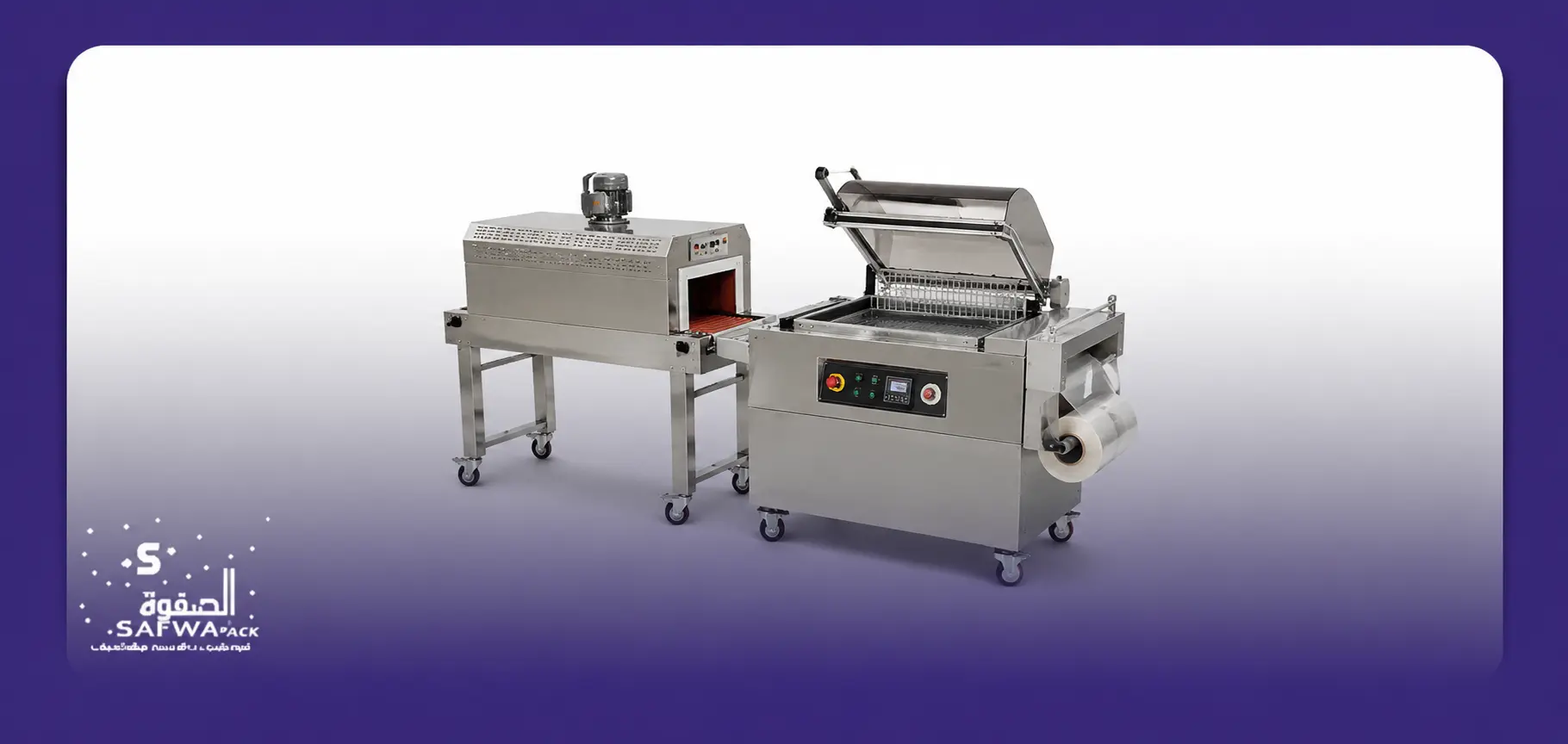
The decision to purchase a heat shrink machine doesn't start with the question "What's the price?" alone. The appropriate machine is determined based on product dimensions, production capacity, type of wrapping film, the degree of automation required, and the nature of integration with the rest of the production line.
The term "heat shrink machines" is sometimes used to describe office document laminating devices, and sometimes to describe industrial shrink wrap equipment. Therefore, this guide focuses on heat shrink machines designed for factories and production facilities, clarifying the differences from A4 laminating machines so that procurement managers can choose the right solution.
If you're planning to establish a new line or develop your current packaging stage, contact Al-Safwah Packaging Machinery Company, and send the product type, dimensions, and required production rate to receive a technical recommendation suited to your actual operating needs.
What Are Heat Shrink Machines and How Do They Work?
Heat shrink machines are equipment that wraps a product with appropriate plastic film, then exposes it to precisely distributed heat until the film shrinks and wraps around the package. The process may start with an independent sealing and cutting unit, then the product moves to a heat tunnel, or both steps may be executed within an integrated machine or within an automatic system connected to the production line.
Industrial heat shrink machines typically operate through the following stages:
- Placing the product inside the shrink film or passing it to the packaging area.
- Cutting and sealing the film around the product.
- passing the package through the tunnel or shrink chamber.
- Adjusting heat and conveyor speed according to film type and product dimensions.
- Cooling the package and inspecting seal and shrinkage quality before assembly or cartonization.
The success of the process doesn't depend on high heat alone, but on the balance between temperature, exposure time, conveyor speed, and material thickness. Any flaw in this equation may result in film wrinkling, weak sealing, or damage to the package appearance.
Why Do Factories Need Heat Shrink Machines?
The purpose of industrial packaging is not limited to improving appearance; it's a stage that affects storage efficiency, handling safety, and consistency of package quality leaving the line. Choosing the right system helps to:
- Protect products from dust, scratches, and environmental factors during handling.
- Group multiple units in one package to facilitate transportation and distribution.
- Present a uniform appearance that increases product readiness for retail display.
- Reduce variation resulting from traditional manual packaging.
- Organize product transfer from packaging to assembly or cartonization.
- Support production expansion when choosing a machine that can be integrated with the line.
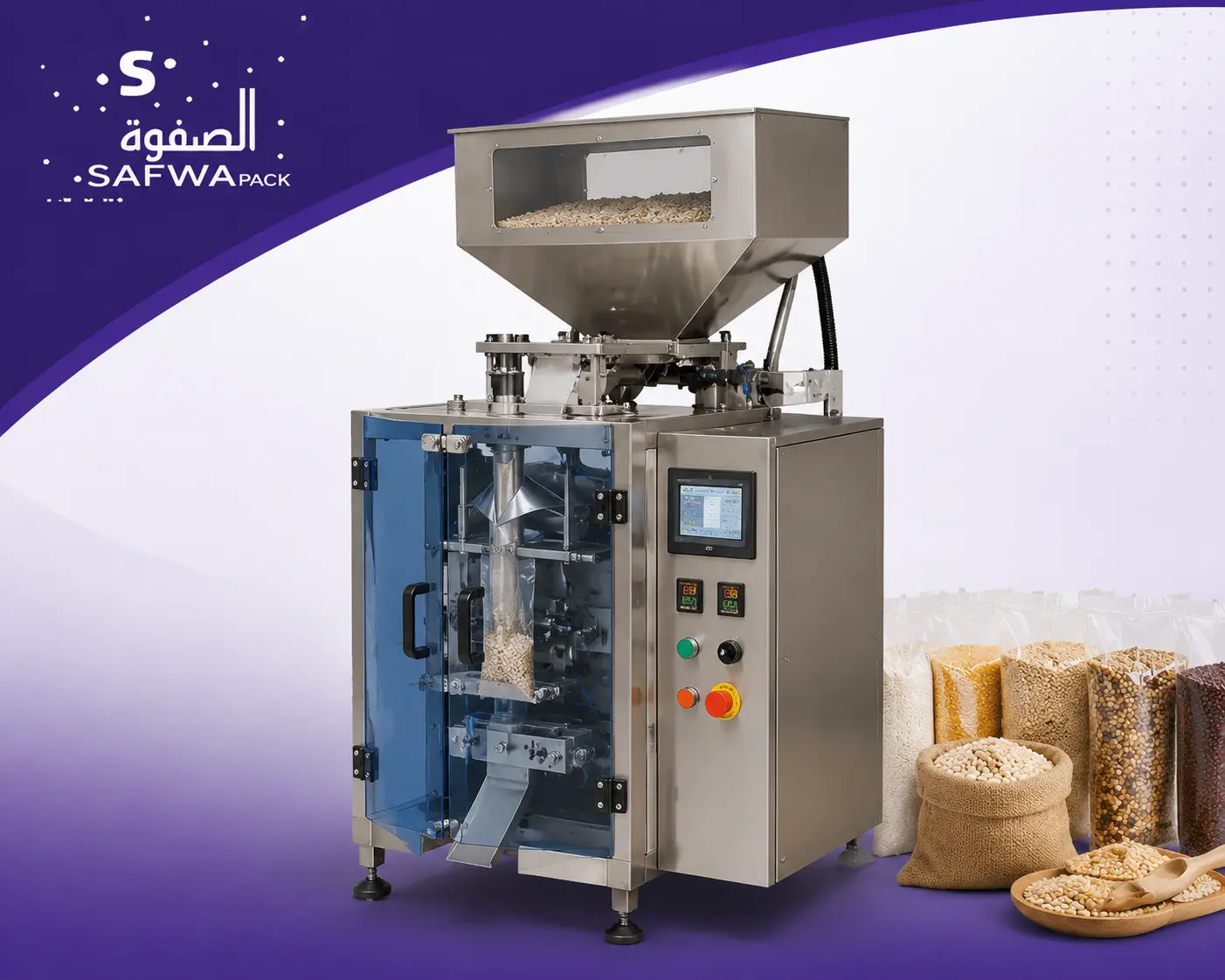
In grain and dry goods factories, the shrink wrap stage may come after weighing and sealing as part of a line that includes a bean packaging machine, where filled packages move to assembly or outer packaging according to line design.
Types of Heat Shrink Machines for Factories and Production Lines
There's no single machine that suits every factory; the choice varies according to the number of packages, size variety, operating space, and investment size. The main types include:
Manual Shrink Machine for Small Projects and Limited Production
It relies on worker intervention in placing the product inside the film and operating the cutting and sealing unit, then passing the package to an appropriate shrink source. It's suitable for limited production lines or factories dealing with diverse products and not requiring high automatic speeds.
Al-Safwah offers an L-shaped manual sealing and cutting unit that works with PVC and POF films, equipped with a timer to adjust sealing time, a roll holder, and an air outlet piercer. For broader details on use and selection, refer to the manual shrink machine guide.
Semi-Automatic Machine with Heat Tunnel
It usually combines a sealing and cutting unit with a shrink tunnel equipped with a conveyor belt. Some handling remains manual, while the machine performs heating and product movement more uniformly. This type is suitable for small and medium factories needing increased productivity without immediately transitioning to a fully automatic line.
2-in-1 Shrink Machine
It combines cutting, sealing, and shrinking within an integrated unit, thereby saving operating space and reducing product transfer between multiple machines. Before choosing it, confirm the packaging chamber dimensions, maximum product size, and actual cycle speed.
Fully Automatic Heat Shrink Machine
It automatically receives products and performs film feeding, sealing, and shrinking with minimal human intervention. It's more suitable for large production lines with uniform products and high speeds. It can also be equipped with entrance and exit conveyors, sensors, and control systems compatible with previous and subsequent line stages.
Shrink Machine for Bundle Packaging
Used to group bottles, cans, or multiple products within one bundle, and may work with polyethylene films according to machine configuration. Here you must define stacking pattern, number of units per group, and bundle weight before requesting a technical offer.
Independent Heat Shrink Tunnel
Used with a sealing and cutting unit, it provides control over temperature and conveyor speed. Al-Safwah offers a desktop tunnel operating at 220 volts, alongside a tunnel with a 25×45 cm opening and electrical options of 220 or 380 volts depending on the model, allowing equipment selection according to operating space and product size.
Quick Comparison Between Manual, Semi-Automatic, and Automatic Heat Shrink Machines
| Comparison Element | Manual | Semi-Automatic | Fully Automatic |
|---|---|---|---|
| Suitable Production Volume | Limited or Variable | Medium | High and Continuous |
| Worker Intervention | High | Medium | Low |
| Size Change Flexibility | Relatively High | Good with Setup | Better with Uniform Products |
| Required Space | Limited | Medium | Larger |
| Investment Cost | Usually Lowest | Medium | Usually Highest |
| Line Integration Capability | Limited | Partially Possible | High |
This comparison is preliminary and doesn't substitute for reviewing specifications; a semi-automatic machine may be more economical than a fully automatic system not operating at full capacity, while manual operation becomes costly if it creates a bottleneck in the packaging stage and disrupts the rest of the line.
What's the Difference Between A4 Heat Shrink Machine and Industrial Shrink Machines?
An A4 heat shrink machine is an office device that packages paper and cards inside laminate pouches to preserve documents, and is used in offices, schools, and printing centers. Industrial shrink machines, meanwhile, package products and packages using film that shrinks around them with heat, and may include a sealing unit, heat tunnel, and conveyor belts.
If your operation is industrial, don't compare an A4 machine with a shrink machine based solely on price; they perform entirely different functions. First determine whether you need document protection or product packaging, then compare equipment within the correct category.
If the required process relies on heat and pressure to attach a layer or cover to the product, this is another category whose cost factors you can understand from the thermal press price guide.
Uses of Heat Shrink Machines in Different Sectors
Uses vary according to film material, machine design, product heat tolerance, and include:
- Food and Beverages: Packaging cans, bottles, jars, and grouping packages.
- Pharmaceuticals and Supplements: Packaging outer boxes and preparing product sets, while complying with factory operating and hygiene requirements.
- Cosmetics and Perfumes: Packaging cream, perfume, and soap boxes to display products neatly.
- Paper Products: Packaging books, tissue boxes, and commercial prints.
- Household and Industrial Tools: Protecting pieces and boxes during storage and distribution.
- Gifts and Consumer Products: Standardizing external appearance and reducing package scratch exposure.
When preparing a pharmaceutical facility, study each stage as an independent system; the selection of tablet production equipment differs from outer packaging. You can refer to the pharmaceutical tablet press price guide when studying the production stage preceding packaging and wrapping.
How to Choose an Appropriate Heat Shrink Machine for Your Factory?
Before contacting suppliers, prepare clear data instead of settling for "I want the best machine." The more precise the operational information, the closer the price offer and technical recommendation will be to your actual need.
1. Determine Product Dimensions and Weight
Record length, width, and height, and the largest and smallest sizes that will be run on the line. This data determines tunnel opening, sealing wire length, and appropriate film width.
2. Determine Required Production
Write down the number of units or bundles to be packaged per hour, and number of operating hours and shifts. Don't buy a machine much faster than your need without an expansion plan, and don't choose capacity less than required that becomes a line bottleneck.
3. Clarify the Final Package Form
Is the requirement to package a single unit, group multiple packages, or place a sleeve around a specific product part? A product photo and sample of required packaging help the supplier determine machine type and film.
4. Choose Automation Degree According to Operations
Compare labor costs, size change speed, product stability, and expansion plans. Manual operation may be appropriate initially, while automatic becomes more logical for continuous lines with uniform sizes.
5. Review Electricity and Factory Space
Confirm available voltage, required electrical capacity, ventilation, product entrance and exit path, and space needed for machine maintenance. Some tunnels come with 220 or 380 volt configurations depending on model.
6. Test the Machine with an Actual Sample
Request a trial on your product and proposed packaging film. Observe seal appearance, shrinkage uniformity, heat effect on the package, ease of adjusting settings, and product quality after cooling.
7. Ask About After-Sales Support
Review training, warranty, spare parts availability, maintenance response time, and what the price offer includes regarding installation or trial operation. Unplanned downtime may cost more than the purchase price difference between suppliers.
If your project combines herb packaging and wrapping, start by determining the appropriate dosing and closure system for the product through the herb packaging machine price guide, then determine whether you need shrinking for the unit or for grouping packages after packaging.
Materials Used with Heat Shrink Machines
Packaging film is determined based on machine type, product, and desired final form, with common materials including:
- POF: Used in multiple applications when a transparent film with uniform shrinkage is required.
- PVC: Compatible with some sealing units and tunnels, and must be operated according to machine settings and material instructions.
- PE: Widely used for grouping packages and bundles requiring stronger film.
Don't choose the material by name alone. Test thickness, sealing strength, shrinkage ratio, film suitability for the product and sector regulatory requirements, then adjust heat and conveyor speed based on sample results.
Factors Determining Heat Shrink Machine Prices
There's no uniform price because cost varies according to system configuration and required specifications. Main factors include:
- Type of operation: manual, semi-automatic, or automatic.
- Dimensions of sealing area and tunnel opening.
- Production capacity and conveyor speed.
- Film type, thickness, and maximum roll width.
- Number of heating zones and temperature control precision.
- Control components, sensors, and conveyor belts.
- Materials for frame and heat-exposed parts.
- Additional equipment required for line integration.
- Installation, training, warranty, and after-sales services.
When budgeting a complete line, review packaging machinery prices to understand equipment differences and operating stages, and distribute budget to each stage according to its actual need.
To obtain a comparable offer, request clear specifications, components, and services, then compare total operating cost, not just supply price.
Mistakes to Avoid When Purchasing Heat Shrink Machines
- Purchasing the machine before actually measuring the largest product.
- Comparing offers by price without standardizing specifications.
- Ignoring film testing on the actual product.
- Choosing theoretical speed not matching worker handling or line speed.
- Overlooking electricity consumption, ventilation, and maintenance space.
- Not asking about spare parts and technical support speed.
- Choosing a manual system for a large line or fully automatic for constantly changing products without study.
- Relying on descriptions like "industrial" or "automatic" without requesting a written technical sheet.
Why Choose Al-Safwah for Heat Shrink Packaging Stage Equipment?
Al-Safwah Company specializes in designing and manufacturing packaging machinery, offering diverse shrink wrap solutions including manual and automatic sealing and cutting units, 2-in-1 machines, desktop and industrial shrink tunnels, and bundling solutions. This variety allows choosing equipment according to product and required capacity instead of relying on a single model for all applications.
Al-Safwah also clarifies through its website the provision of customized solutions for various sectors, technical support, and after-sales services. Therefore, production or procurement managers can discuss the complete stage configuration, from package size and film to electricity, conveyor belts, and integration with the rest of the line.
Choosing appropriate heat shrink machines reduces the risk of purchasing equipment larger or smaller than factory need. Send the Al-Safwah team the product type, dimensions, package photo, number of units to be packaged per hour, required bundling type, and available electrical voltage; a suitable solution will be evaluated and a clear technical and commercial offer prepared.
Contact Al-Safwah Packaging Machinery Company now for technical consultation to help develop your packaging stage and achieve more stable operation within the production line.
Frequently Asked Questions About Heat Shrink Machines
What's the Best Heat Shrink Machine for the Factory?
There's no single model that's best for everyone. The choice depends on product dimensions, production rate, film type, whether you need to package single units or group packages, and appropriate automation degree.
Is a Manual Shrink Machine Suitable for Project Start-up?
Yes, it may suit limited or variable production when the priority is reducing initial investment and flexibility. However, compare its actual capacity with the required production rate so the packaging stage doesn't become a bottleneck.
Can a Shrink Machine Be Connected to an Existing Packaging Line?
This is possible in many cases, provided conveyor height compatibility, product entrance speed, package dimensions, control system, and factory space. Line integration should be technically evaluated before purchase.
What's the Difference Between Shrink Tunnel and Sealing and Cutting Machine?
The sealing and cutting unit closes the film around the product and cuts excess, while the shrink tunnel exposes the package to hot air until the film shrinks around it. The two units may come separate or integrated within one machine.
What Data Is Required for an Accurate Price Quote?
Send product type, dimensions, and weight, production rate per hour, photo of required packaging shape, film type if specified, electrical voltage, available space, and any equipment you want connected to the machine.